Moonshots are hugely difficult, highly creative, innovative projects with audacious goals.
Those aren’t the typical words you’d use to describe B2B content marketing.
But if you find yourself at the lower left or upper right of the matrix below, it may be time to get out of your comfort zone and aim for the moon.
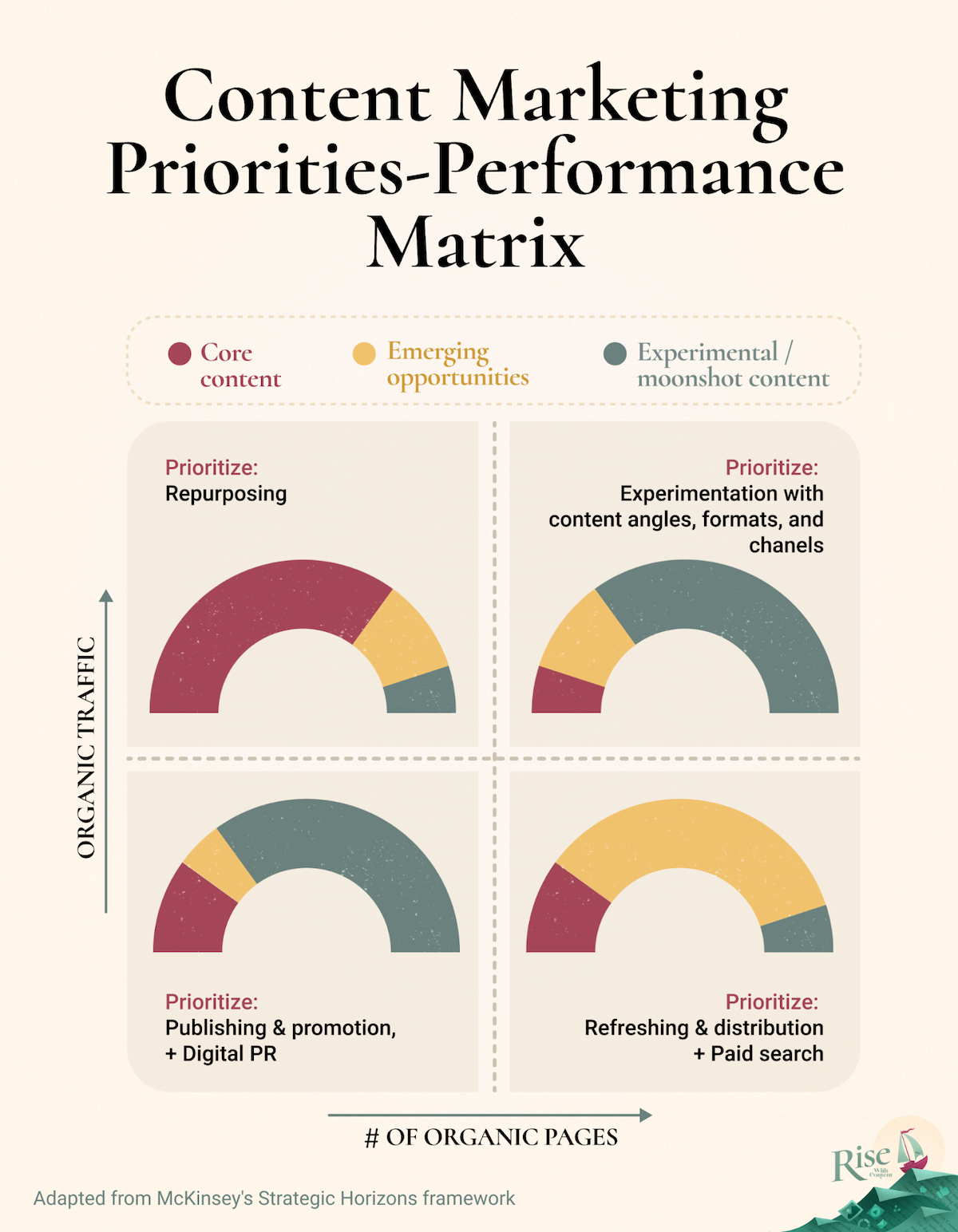
If you’re on the lower left, you might be like the wallflower that finally dares to belt out a ballad on karaoke night.
If on the upper right, you might be like the popular but aging musician that learns a new instrument or ventures into another genre — you need to keep surprising and delighting your audience, and capture the next generation to stay relevant.
Both situations require you to do something new, or to do something usual at a scale you haven’t attempted before.
Something that captures your target audience’s increasingly elusive and precious attention, and differentiates you from your competitors.
Something that harnesses creativity as a force multiplier and boosts your share of voice, thus making your brand known and remembered by many people.
In other words, a marketing moonshot.
(We explain the above framework in more detail here.)
Choosing your moonshot
A moonshot in content marketing is a campaign that helps you achieve outsized impact rather than incremental gains.
It doesn’t have to be a crazy idea.
In fact, your mileage may vary — a moonshot for a marker with a restrictive company culture might be business-as-usual for a marketer in an innovative startup.
A moonshot for a marketer with low tech and little budget may be regular programming for a marketer with tons of resources.
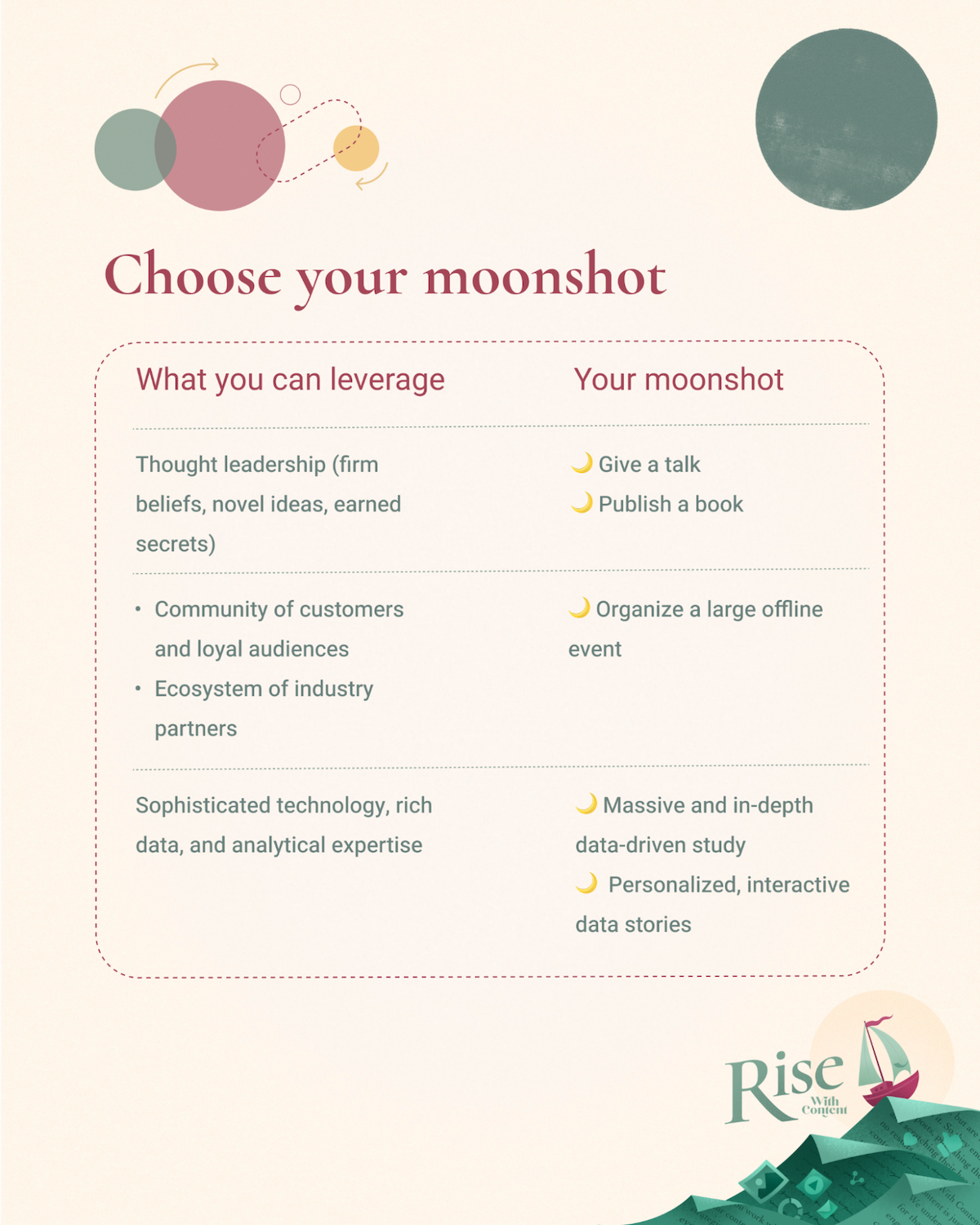
This isn’t to say moonshots are arbitrary. Use your company’s content marketing strengths as your guide to choosing a moonshot. What can you leverage that your competitors either don’t have or aren’t harnessing enough?
Here’s an example.
In its early growth years, Seedly, a Singapore-based personal finance startup, started building a community around its content. They eventually leveraged their community by launching the Seedly Personal Finance Festival. At the event, they invited a local radio station to boost reach and credibility. It has since become an annual event and the largest personal finance festival in Singapore — a moonshot turned into a recurring venture.
This post was first sent to Rise newsletter subscribers on November 1, 2024. Be the first to read our tips and insights next time. Subscribe to Rise now
How to mitigate risk
In the matrix above, you’ll see that we’ve categorized content into three types: core content, emerging opportunities, and moonshots.
This is an adaptation of McKinsey’s Three Horizons framework, which “illustrates how to manage for current performance while maximizing future opportunities for growth”.
In short: protect and sustain your present success, while setting yourself up for future wins.
Even as you pursue a moonshot, continue to nurture your other content:
Core assets and channels that serve as your content marketing foundation.
- These have enabled you to attract audiences, build your brand reputation, and capture inbound leads.
- Format examples: pillar pages, case studies, newsletters
- Topics: The pain points your product solves for your primary target customers.
Emerging opportunities based on marketing and industry trends.
- These allow you to test new methods and content categories, and assess whether they’re worth incorporating into your core content marketing engine.
- Format examples: B2B influencer partnerships, person-led thought leadership on LinkedIn, co-marketing podcasts
- Topics: Pain points you could solve for customers in adjacent categories.
Identifying your spot on the Priorities-Performance matrix
To determine your position within the Content Marketing Priorities-Performance Matrix, use a tool like Ahrefs or Semrush. Enter your blog URL path into the tool (not your website, just the URL path. For example: withcontent.co/blog).

You’ll see something like this:
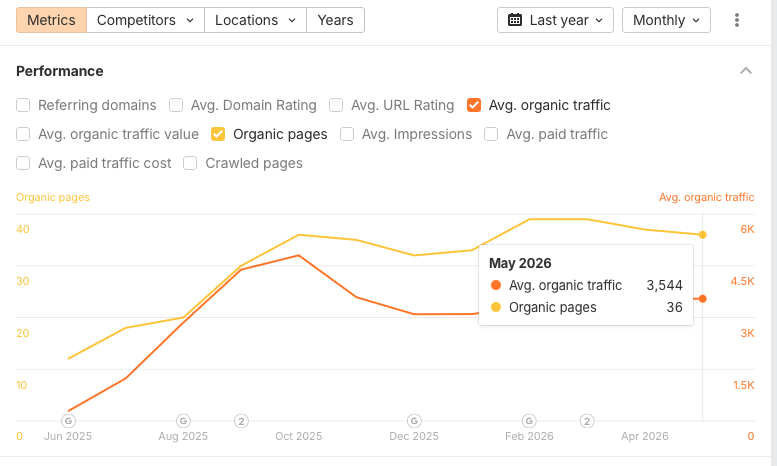
This screenshot shows data for our client’s niche blog. I’ve checked the boxes for “organic pages” and “organic traffic” to show only those data. Based on this data, there’s almost a hundredfold difference between the number of organic pages on the blog versus the amount of organic traffic it gets.
The most likely reason is that a handful of pages are driving the bulk of the traffic. To investigate this theory, click on the “top pages” function (on Ahrefs, you’ll see this on the sidebar). For this client, one blog post drives nearly half of all blog traffic:
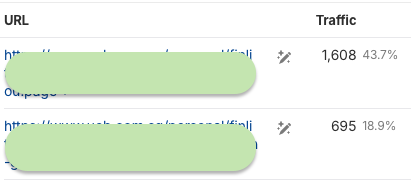
This simple investigation hints that you’re at the top-left of the matrix. Your core content is on the right track but you need to work harder on repurposing and amplifying the articles with lower traffic volumes. At the same time, find shorter paths to winning your audience’s attention by capturing emerging opportunities. Build a content production rhythm for these two areas — core content and emerging opportunities — before allocating resources to experimental content.
Remember the rest of the picture
The Content Marketing Priorities-Performance Matrix provides you one angle for tackling content strategy — but it barely covers the entire picture.
You can conduct a multi-faceted analysis by using other content strategy frameworks, as well as digging deeper into the data with a full content audit.
A content audit is analysis of the existing content on your website. The scope of a content audit includes:
- topics and funnel stages covered
- audience segments and pain points addressed
- alignment with product proposition and key brand message
- E-EAT compliance
- SEO + AEO + GEO
- Organic performance (traffic, keywords, backlinks)
- On-page engagement
Such data can give you a year’s worth of content marketing priorities to consider — from refreshing old, top-performing blog posts to updating your entire content library to ensure alignment with business priorities. But instead of simply checking off items on a list, you’ll have an evidence-based content strategy to guide your B2B marketing activities.
Let our strategists help you get started. Reach out to schedule a discovery call with us.
—
200+ industry-leading tech companies in Southeast Asia are happy clients of With Content. Join them and start delivering valuable content to your potential customers today.